Sexual harassment in medicine
“The standard you walk past is the standard you accept”
Sexual harassment between doctors is a common problem hiding in plain sight. There have been prevalence studies across the world, across contexts and across disciplines and although definitions, methodologies and results vary, the one thing they all have in common is that prevalence is well above zero. Harassment is more common when the survivor is still in training, and it is more likely to be experienced by doctors who live with multiple marginalisations.
Our journey into this difficult landscape started in 2014 and culminated into our international book published in April 2026 by Cambridge University Press.
-
Our first paper mapped out the landscape, and we realised then that this is a complex problem, which is culturally bound. In this paper, we discuss the breadth of the problen
“Sexual harassment and sexual assault are illegal, deeply traumatic and profoundly unprofessional. However, given the ongoing harassment of medical students internationally, it is likely that this abuse is an entrenched part of medical culture. … It is high time the profession critically examined this problem from multiple perspectives and provided a multifaceted, committed and evidence-based approach to changing this toxic culture.”
-
In our qualitative study on sexual harassment in medicine, we interviewed a number of survivors in depth over time. We realised the impact of sexual harassment in medicine led to a long tail of trauma
“If we are to manage the impact of doctors’ sexual abuse of junior doctors, we need to support all stages of the trauma and recovery trajectory. We need to continue to prevent sexual abuse and work to reduce the power differentials that make abuse possible in the medical workplace. We also need to have better policies and processes in place to ensure effective support of survivors when sexual abuse occurs. Finally, survivors need restorative justice: a mechanism to reintegrate them into the professional institutions that have deeply betrayed their trust.”
-
Prof Ros Searle’s team have explored how the public are involved in the regulation of health and social care professionals in the United Kingdom. They can be investigated. In the most serious cases, this might include a public hearing where a decision will be made about whether they can continue to practise. This process is called fitness to practise. The process is stressful for professionals.
The team wanted to find out how the process works for the public, who may be involved by raising a concern and by giving evidence at a hearing. They focused on people who may have been harmed by professionals, because little is known about their experiences of fitness to practise.
They examined the information for the public on 13 regulators’ websites and undertook a survey of people who had raised a concern, interviewing people who had been part of a hearing. They examined documents, including witness statements, legal documents and policies, and observed hearings. They interviewed the public, lawyers and independent hearing panel members and held four workshops to coproduce recommendations with members of the public, regulators, health, social care, lawyers and academics.
They found that most of the regulators’ websites presented too much or too little information, which was too complex, in inaccessible formats and made the process of navigating the website difficult. Members of the public who had been harmed and who raised a concern and took part in investigations and hearings mainly found the process to be onerous, protracted, distressing and disappointing. Regulators and employers often did not offer enough support to the public. The team produced recommendations and resources to improve these processes.
-
At our international summit on sexual harassment in medicine, we brought together people at all levels of experience - students, young professionals and leaders- from law, medical education, medical regulation, management, advocacy, medical colleges and Universities.
Together, we tackled some of the hardest challenges in this field, understanding the way health promotion needs to occur from primary to quaternary prevention. -
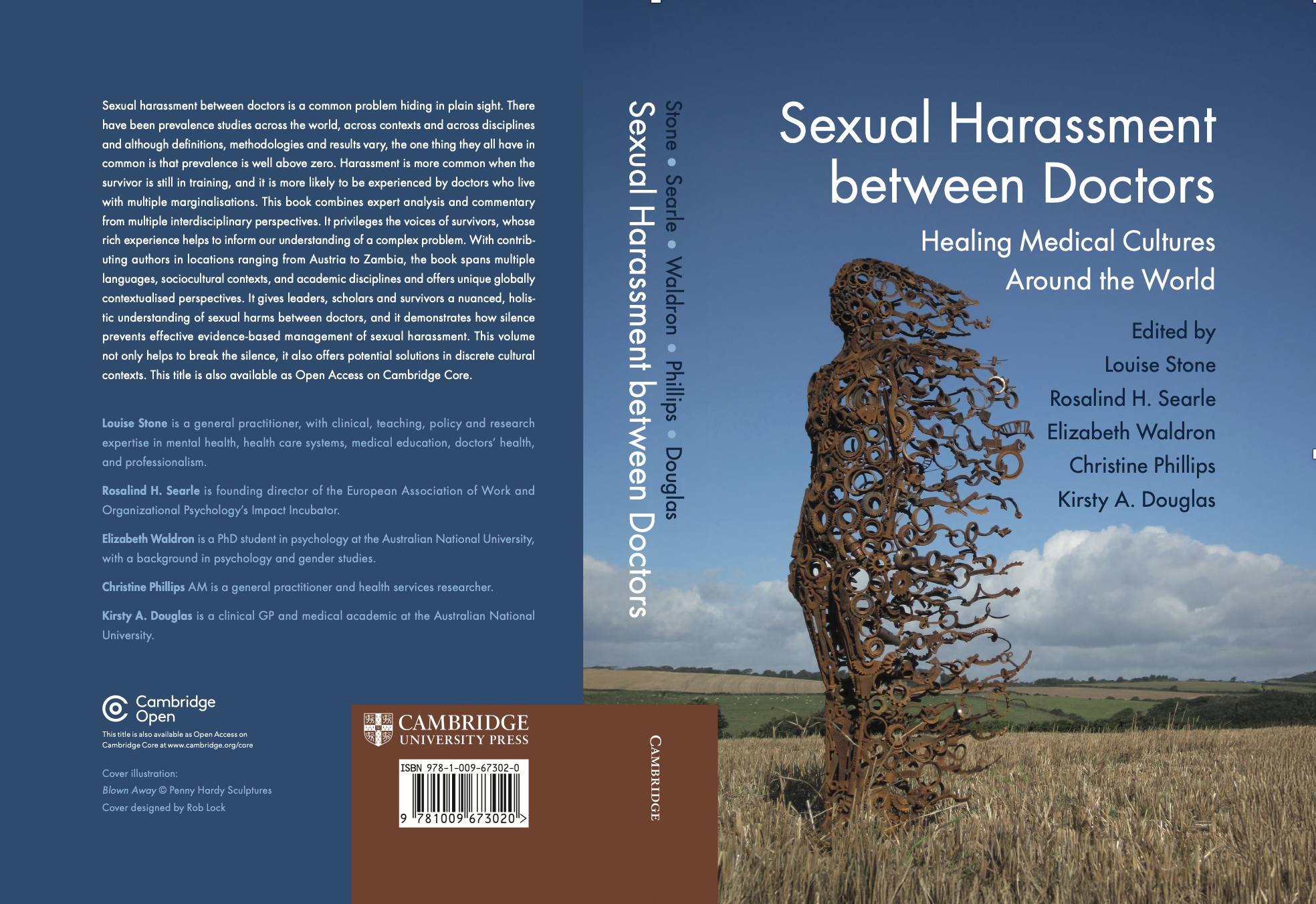
Our book “Sexual harassment between doctors: healing medical cultures around the world” combines expert analysis and commentary from multiple interdisciplinary perspectives. It privileges the voices of survivors, whose rich experience helps to inform our understanding of a complex problem. With contributing authors in locations ranging from Austria to Zambia, the book spans multiple languages, sociocultural contexts, and academic disciplines and offers unique globally contextualised perspectives. It gives leaders, scholars and survivors a nuanced, holistic understanding of sexual harms between doctors, and it demonstrates how silence prevents effective evidence-based management of sexual harassment. This volume not only helps to break the silence, it also offers potential solutions in discrete cultural contexts. This title is also available as Open Access on Cambridge Core.

Sexual harassment between doctors
healing medical cultures around the world
“There isn’t anything you can be, do, wear, or say to stop people harassing or assaulting you ... the only thing that predicts any person being victimised is being next to an unchecked predator. ”
— Anonymous personal account, Surviving in Scrubs
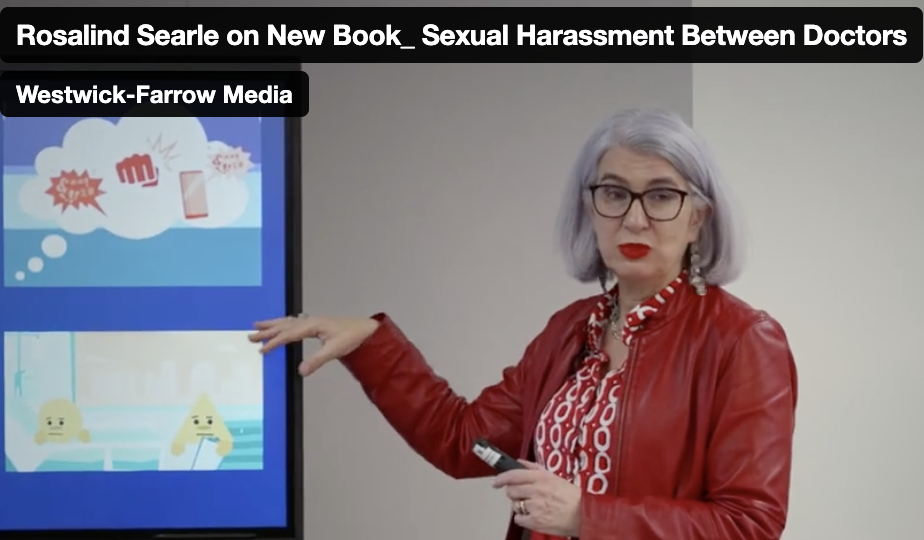
Professor Rosalind Searle, University of Glasgow
“In 2014, I looked after a young intern who was sexually assaulted by her supervising consultant while on the way to the car park after a night shift. As a GP with a long-standing interest in mental health, I had seen hundreds of survivors of sexual trauma in my clinic, but this consultation felt profoundly different.”
“The therapeutic relationship felt fragile, trust was hard-won and the shame in the room was deep. In retrospect, these difficulties were unsurprising. The intern was a doctor, the consultant was a doctor, and I was a doctor, so there were complexities in the therapeutic relationship. I was therefore part of a community that had been complicit in the abuse.”
This book is dedicated to the survivors who have experienced sexual harm in our community and on our watch.
We recognise and thank the whistleblowers, who have risked their own professional reputations to stand up for what they know to be right. We also recognise the researchers, educators, regulators, managers, lawyers, supervisors, colleagues and therapists who have mitigated sexual harms in their own ways, their own contexts and their own time.
The voices of survivors have been silenced by individuals, organisations and the insidious impact of hidden medical cultures. Their trauma has been deep. Doctors are dedicated to healing. They should not need to endure abuse from senior colleagues within their workplace in order to practise their profession.
For those who have suffered sexual harassment or abuse, we hope you are able to find some guidance and solace in this book. You are not alone, and the stigma, shame and silence that surrounds sexual trauma is not yours to carry.
Contents
-
Foreword: The Shame of Sexual Violence Is Not the Victim’s Burden to Carry
Yoo Young (Dominique) Lee
The Foreword is written by a survivor of sexual harm in medicine. The author is an Australian doctor, who was abused by her supervisor. The perpetrator pleaded guilty in the criminal court, and was convicted and sentenced to a period of imprisonment. Because this case is well described in the public domain, it is possible for this author to reflect openly on the case. The foreword contextualises the theoretical analysis and findings offered by the main text by offering an exemplar of how they can translate to an individual’s lived experiences. It also uses that lived experience to illustrate the ultimate rationale and core aims underpinning the book: to improve the provision of care for doctors who experience sexual harms, and also improve the safety of the medical workplace.
-
Louise Stone
The Preface provides a reflexive overview of the context in which the lead author initiated the pilot study (Stone et al., 2019) and ultimately this collaborative research anthology. It discusses the aims and rationale for the book, and briefly introduces the ethical, philosophical, and disciplinary orientations underpinning the editors’ approach to this text.
-
Louise Stone and Elizabeth Waldron
Part one provides a brief holistic introduction to the issue of sexual harms in a broadly international scope. It contains chapters that draw on expertise from social science disciplines to provide theoretical context regarding the ways that gender, medicine, and marginalisation and power operate and interact.
-
How to Be a Woman Doctor: Gender, Performance and Sexual Risk
Christine Phillips
In this chapter, Phillips provides an overview of the issues around gender in medicine. Medicine has a highly gendered history, and although women are well represented in medical school, medical leaders are still predominantly men, particularly in disciplines of high prestige, such as surgery. The author considers medicine as a hegemonically masculine institution, and reflects on the complex embodiment of a woman doctor in such an environment. They describe how sexual discomforting of women – patients and clinicians – can become routinised under hegemonic medical masculinity. Performing gender in a professional way often involves women doctors distancing themselves from the troubling fact of their own bodies. The authors propose that this contributes to heightened sexual risk in the medical workplace.
-
Rachel Roberts and Sanjiv Ahluwalia
In chapter three, Roberts and Ahluwalia bring their expertise in education, management, policy and leadership to examine the role of men. Although the evidence suggests that the perpetrators of sexual harassment are usually male, survivors are from all genders. Male survivorship is not well represented in the literature, and their voices are rarely heard. The role of men in allyship, leading and supporting teams in the prevention and management of sexual harassment is highlighted in this chapter, and the authors emphasise the critical role of bystanders in preventing and managing sexual harms.
-
Elizabeth Waldron and Louise Stone
This chapter tackles the difficult challenge of outlining changing concepts and approaches to sexual harassment in the workplace, beginning from a historical position where sexism tended to be normalised, to a much more challenging and complex sociocultural environment where workplaces are expected to provide a psychologically safe environment. This chapter attempts to capture how workplace harassment, gender-based violence and gender-based discrimination have been challenged in different global contexts and in different times in history.
-
Christine Phillips
Chapter five outlines the variety of medical workplaces in which doctors work, from relatively solitary situations (e.g. primary care in remote communities) to highly institutionalised large companies, such as tertiary hospitals. Medical work is also diverse, ranging from clinical roles, to teaching, education, research, policy and leadership. Some medical workplaces are highly hierarchical, while others promote interdisciplinary working, where health professionals work in partnership with individuals and the community. The diversity in the nature and structure of medical work changes how misconduct can be prevented and managed.
-
Louise Stone, Paul McGurgan, Rose Petrohilos, Rebecca Fisher, Simon Fleming and Tim Senior
In this chapter, a team of medical educators, academics, clinicians and doctors in training collaborate to describe how doctors are trained around the world. Although there is significant variation in the approaches to medical training, there are also significant similarities. In this chapter, the team explore the way hierarchy is managed, the approach to teaching the science, art and craft of medicine, the
choices around making curriculum globally consistent or locally relevant, and the management of learning environments to ensure doctors in training are safe. This chapter pays particular attention to the hidden curriculum, and how learners are enculturated into the social world of medicine, shaping who they are as doctors, not just what they do.
-
Michael Botha and Marie Bismark
Botha and Bismark explore the impact of sexual harassment on colleagues, on the workplace as a whole and on patients. In the past, there has not been a particular focus on the behaviour of professionals towards other professionals, as professionalism has tended to be more concerned about behaviour towards patients. However, it is now known that interprofessional communication and relationships have an impact on patient safety. This chapter explores that impact.
-
Rosalind H. Searle, Erica Bowen and Louise Stone
The team of authors for chapter eight look at what is known about the type of workplace interventions that have been used to prevent, reduce the impact of and minimise the harms of sexual harassment. This chapter summarises the evidence behind potential strategies using the framework of primary, secondary, tertiary and quaternary health promotion.
-
Louise Stone
In this part, we examine the multiple disciplines involved in the prevention and management of sexual harassment and describe common dilemmas faced by the organisations tasked with managing harassment in the medical workplace. Every organisation has strengths and capacities, but they also have limitations in their ability to manage sexual harassment. In this part, we have asked experts to analyse the problem from within their discipline, and describe the strengths and limitations of their organisational approach.
-
Organisational Behaviour: ‘Oops I Did It Again!’ –Understanding Sexual Harm in Medicine and Why It Persists
Rosalind H. Searle
Searle examines the evidence behind workplace responses to harassment, and discusses some of the dilemmas facing management. While sexual harassment clearly causes harms to employees and clients, exposing sexual harassment can cause reputational damage and reduce trust in the organisation. There is also evidence that the reporting process can be highly traumatic for survivors. The perpetrator is likely to be more senior than the survivor, and may well be a high profile asset for the organisation. The survivor is likely to be a more junior and more temporary employee with less notional value to the workplace. This power differential makes management particularly difficult, as the perpetrator may not be easy to replace. There is also a fine balance needed between openness and transparency, protecting the survivor from re-traumatisation and victimisation when their name becomes known in association with the harassment. Searle proposes a health promotion framework of primary, secondary, tertiary and quaternary interventions to manage harms from sexual harassment in the medical workplace.
-
Ian Freckelton
The chapter on law examines some of the barriers to justice and fairness in legal systems. As a barrister, Freckelton brings his detailed understanding of the cultural and structural barriers to reporting through legal channels. He uses three case studies from Australia to illustrate the challenges of reporting sexual harm through criminal and civil courts and tribunals, recognising how the system itself causes harm to survivors. He describes how legal processes may fail, so that despite the personal and professional risks a complainant endures, the outcome may not prevent future harm, or deter the perpetrator from future misconduct.
-
Adrienne Ringin
Ringin presents her work on human rights organisations, discussing their achievements and limitations. Although human rights frameworks have led to standard setting across the world, they offer little to an individual in terms of timely redress. However, the value of human rights work lies in collective advocacy. Common data, language and criteria enable grassroots organisations to agitate for collective rights at a local and national level. Over time, human rights principles can drive changes in legislation, so that workers can be protected under law.
-
Alison Reid
Health professionals, including doctors, are in a unique position because they may be accountable to a medical regulator as well as to local legislation. Medical regulators exist to set and maintain professional standards, so that the public are protected from health professionals who demonstrate practice that puts the public at risk. With sexual harassment, there are different regulatory standards around theworld. Reid uses her leadership of the International Association of Medical Regulatory Authorities (IAMRA) to highlight the common key processes of medical regulation agencies internationally and the significant differences between them. Medical regulators hold an important role in disciplining practitioners whose behaviour does not explicitly meet the legal threshold required for consideration in local courts. However, the differences between agencies and jurisdictions can mean it is difficult for a survivor to clearly understand and utilise these processes effectively.
-
Louise Stone, Paul McGurgan, Rose Petrohilos, Rebecca Fisher, Simon Fleming, I Nyoman Sutarsa, Tim Senior and Fiona Moir
This chapter highlights several major limitations for survivors who are still doctors in training. The steep professional hierarchy and the blurring of roles in teaching and supervision mean learners may be very dependent on their senior colleagues for career progression. This means that doctors in training may be reluctant to report sexual harassment due to concerns about the impact on their careers. In addition, workplace-based learning means doctors in training may be managed under two distinct policy frameworks: one at the workplace and one with the institution who oversees their learning. This can mean that survivors may have difficulty understanding their options when attempting to report abuse. They may also choose to avoid reporting simply because they move between teams relatively rapidly, and so may choose to endure the abuse and ‘move on’ rather than begin a lengthy reporting process that will last longer than their placement. Finally, the chapter explores the challenges of identifying, remediating, and, if necessary, removing doctors in training from the profession.
-
Leslie Flynn and Amber Hastings-Truelove
Hastings-Truelove and Flynn outline some of the challenges faced by doctors when they seek therapy. Apart from the obvious blurring of boundaries when seeking therapy inside a community that causes harm, there are defence mechanisms used by doctors that can impede the ability of survivors to seek and engage in therapy at all. In this chapter, the authors explore strategies to encourage survivors to seek care, and to overcome the stigma and shame that often accompanies trauma.
-
Rachel Roberts and Sanjiv Ahluwalia
This chapter explores how each of these disciplines can be integrated to ensure that survivors are able to access care and that organisations can draw on multidisciplinary approaches to prevention and management. This chapter discusses an integrated and holistic approach to preventing, responding to and managing sexual abuse of doctors, focusing on organisational as well as individual factors. Using a case study, they explore how different organisations can work together to achieve better outcomes in prevention and management.
-
Learning From International Perspectives
In this part, we focus on a different type of evidence, using lived experience narratives as a form of in-depth case history with expert interpretation. We already see lived-experience narrative evidence from a series of retellings in mainstream, academic and social media. Social media movements, such as #TimesUp from the USA, #UtanTystnadsplikt from Sweden, #MeoQueridoProfesor from Brazil, and #Sex4Grades from Nigeria, document lived-experience cases occurring around the world. By engaging with the problem of sexual harms in medicine in their own unique contexts, authors in part three provide multiple perspectives on the experience or survivors and the response of the profession. They provide contextually relevant interpretation of experience from their own unique contexts, reflecting on the ways in which their context shapes
and responds to this sexual harassment. In this respect, they support decades of scholarly efforts to explore and articulate the social and cultural dimensions of occupational sexual harms.
Each chapter includes a brief description of the cultural context in which the study takes place, and a reflective essay that uses the case study and context to guide analysis and reflection on that nation’s achievements, failures, barriers, and potential new directions for occupational sexual harms
-
18 Australia
Louise Stone, Elizabeth Waldron and Yoo Young (Dominique) Lee
19 Austria
Heidi Siller, Lisa Kelm and Margarethe Hochleitner
20 International Medical Graduates: Brunei
Valerie Chua and Josephine Canceri
21 Germany
Pia Djermester and Sabine Oertelt-Prigione
22 Iran
Parisa Pakdel
23 Japan
Kotoko Mizuno, Kaori Kono, Yasuhisa Nakano and Takashi Watari
24 Malaysia
Sajaratulnisah Binti Othman, Betty Yeoh Siew Peng and Christine Shamala Selvaraj
25 Mexico
Diana Guızar-Sanchez, Ricardo Martınez-Tapia, Rau l Sampieri-Cabrera and Elba Campos-Lira
26 Nigeria
Dabota Yvonne Buowari
27 Pakistan
Hina Jawaid, Tehzeeb Zulfiqar and Humaira Khattak
28 United Kingdom
Clarissa Fabre
29 United States of America
Christine Heisler, Melissa Blaker, Elizabeth Stephens, Michael Sinha, Kate Walsh, Pringl Miller, Sarah Temkin.
30 Zambia
Jane Kabwe, Maria Akani, Sharon Kapambwe, Chali Mbewe Hambayi, Grace Mwila and Mwansa Ketty Lubeya
-
Louise Stone
This section describes the vision, approaches, successes and failures of advocacy in this space. It includes theories from gender studies and political sciences, and explores the role of advocates in grassroots organising, non-government organisations, leadership within organisations and institutions, and doctors in training aiming to improve the professional culture of the next generation of doctors. Finally, we examine the future of therapy in mitigating the harms experienced by survivors.
Together, the chapters in this part work to represent different ways of creating change. These efforts will always be more effective if the organisations around them provide transparent, consistent and trauma-informed policies that clearly align across the multiple actors in this complex policy environment. Collusions of anonymity that exhaust the survivor prevent effective management of abuse and, in doing so, maintain a culture that causes long-term harm.
-
Cultural Change from Above and Within: Accountability in Leadership
Deborah Cole and Elizabeth Teisberg
Elizabeth Teisberg and Deborah Cole consider the leadership challenge of being CEOs in organisations with poor culture. They describe how they, as managers, addressed this challenge to ensure a safer environment for their employees. In doing so, they discuss the personal and organisational strategies they use to achieve a lasting cultural shift.
-
Louise Stone, Betty Yeoh Siew Peng, Dabota Yvonne Buowari, Simon Fleming and Esperanza Martinez
In this chapter, authors from diverse backgrounds reflect on their roles as advocates, using the
lessons they have learned in their various contexts. Advocacy can occur on multiple levels, from one on-one support to national or international campaigns. Using examples from their own work around sexual safety, they discuss the challenges of communicating effectively with a variety of audiences, and engaging people with different points of view.
-
Looking to the Future: The View from Learners and Teachers throughout Medical Training
Louise Stone, May Erlinger, Chelcie Jewitt, Becky Cox, Simon Fleming and Fiona Moir
It is expected that strategies to change culture will differ according to the position advocates hold in an organisation. This chapter includes commentary by a medical student (Erlinger), doctors in training (Cox, Jewitt and Fleming) and medical educators for undergraduates and GPs in training (Stone and Moir). Together, these authors discuss the different ways change can be achieved, utilising the different forms of power and agency available to them at different stages of their careers.
-
Recovery: Rehabilitating the Sense of Self
Jo Stubley, Victoria Lister and Louise Stone
In this chapter, we focus on therapy, which is where this book began. The very first stage of recovery from sexual abuse is recognising the abuse, as it is frequently buried under natural defences like dissociation. The second stage involves breaking the silence to enable a survivor to tell their story. Sexual harassment can cause a significant psychological wound that needs expert treatment, and in this chapter, we consider what that treatment may entail, across the entire trajectory of trauma.
-
Louise Stone and Rosalind H. Searle